To protect an RV from the Florida sun, treat UV as a year-round threat rather than a summer one. Keep the rig clean every two to four weeks so baked-on dirt can’t amplify the damage, put a real UV barrier on the gelcoat (a ceramic coating holds up far longer here than wax), condition the roof two or three times a year, and shade or cover the RV whenever it sits. Do that and your gelcoat stays glossy for years. Skip it, and a Central Florida rig can go chalky in under two seasons.
I’ve detailed RVs across Central Florida for years, and the single most expensive mistake I see owners make is treating sun protection like something you do once, in spring, the way folks up north do. Florida doesn’t work that way. Here’s the exact playbook we use to keep a rig from fading, plus what to do if yours is already starting to chalk.
Why is the Florida sun so hard on an RV?
Because there’s no off-season. Most RV sun-damage guides you’ll find online are written for a May-through-August “peak UV season” followed by fall storage, which is the northern reality. In Central Florida, the UV index sits in the EPA’s “protection needed” range (3 or higher) for most of the calendar year and climbs into the “very high to extreme” band (8+) from spring clear through fall, per the EPA UV Index Scale. We see fresh oxidation come back on a customer’s rig in January, not just August.
That matters because the damage is cumulative. A rig parked uncovered here is taking UV nearly twelve months a year, so the protection that would carry a Michigan camper through a season burns off a Florida rig in a fraction of the time. Prevention here is a continuous habit, not an annual chore.
What is the sun actually doing to the gelcoat?
Your RV’s shiny outer skin isn’t paint. It’s a pigmented layer of polyester resin called gelcoat, laid over fiberglass. “RV fiberglass oxidizes when UV rays, heat, and moisture break down the protective gel coat,” as the RV insurer Roamly puts it in its care guide (Roamly). The UV snaps the resin’s surface molecules apart, the pigment loses its grip, and it turns to loose powder sitting on the surface. That’s the chalky white haze that comes off on your fingertip when you wipe a sun-baked panel.
Left alone it only gets worse: first the gloss drops, then the surface goes chalky and dull, and if it runs for years the gelcoat thins to the point where you’re looking at gelcoat repair or a respray instead of a polish. Protecting the finish is cheap. Rebuilding it is not.
Where does an RV fade first?
Not evenly, and knowing the pattern tells you where to focus. On nearly every Florida rig we touch, three areas chalk first: the front cap, the driver-side wall, and the roof. The front cap and one sidewall take the worst of the low morning and afternoon sun as the rig sits, and the roof bakes under overhead UV all day. If you want a quick read on your own RV, do the fingertip test on those spots: press a clean finger to a sunny panel and drag it a couple of inches. A clean finger means the gelcoat is still healthy; light white dust means early oxidation; heavy chalk means it’s already advanced.
The year-round Florida protection playbook
Protecting a rig here is a layered system, not a single product. Here’s the order we work in.
1. Keep it clean, every two to four weeks. Dirt, pollen, and especially Florida love-bug residue are acidic and hold heat against the gelcoat, which accelerates UV breakdown. A regular rinse-and-wash isn’t cosmetic; it removes the stuff that makes the sun’s job easier. For a daily-driver schedule and the right way to wash without dragging grit across the finish, we laid it out in our guide on how often to wash and wax an RV in Florida.
2. Put a real UV barrier on the gelcoat. Clean gelcoat with nothing on top is unprotected gelcoat. You have three honest options, and in this climate they are not equal:
| Protection | What it does | How long it lasts in Florida sun |
|---|---|---|
| Spray wax / hand wax | Adds a thin sacrificial layer that reflects some UV | Weeks, not months; it burns off fast here |
| Synthetic sealant | A more durable polymer barrier than wax | A few months with upkeep |
| Ceramic coating | A hard, bonded, hydrophobic shell that sheds UV, bug acid, and water spots | A year or longer per application |
In Central Florida, wax is a stopgap. The reason we steer most RV owners toward a professional RV ceramic coating is simple math: one coating that carries the finish through a full year beats a wax you’d have to redo every few weeks to keep up with the UV here.
3. Protect the roof separately. The roof takes more direct UV than any other surface, and it’s the one owners never look at. We recommend having it cleaned and conditioned two to three times a year for a Florida rig. It’s exactly the service the forums mean when they mention “the commercial guys in Central Florida who come condition the roof.” Our RV roof cleaning and sealing service handles that, and skipping it is how small roof issues turn into leaks.
4. Block the sun when the rig is parked. The cheapest UV protection is shade. Covered or indoor storage, a carport, or a quality breathable cover during long sits all cut exposure dramatically. A caution for Florida specifically: never throw a cover over a dirty, damp rig, and never let a loose cover flap in the wind, because trapped grit and movement will scratch the gelcoat worse than the sun would.
Wax or ceramic coating: what actually holds up in Florida?
For a Florida RV, ceramic. Wax and spray sealants have their place for a quick refresh, but they’re sacrificial by design, and our climate eats through them fast; we routinely see a hand wax gone in weeks on a rig that lives outdoors. A ceramic coating bonds to the gelcoat and resists UV, love-bug acid, and hard-water spotting for twelve months and then some, which means the finish spends that whole stretch protected instead of slowly chalking between wax jobs. If your rig is a long-term investment you plan to keep or resell, the coating is the one that protects the gelcoat, and the resale value tied to it.
What if my RV is already chalky?
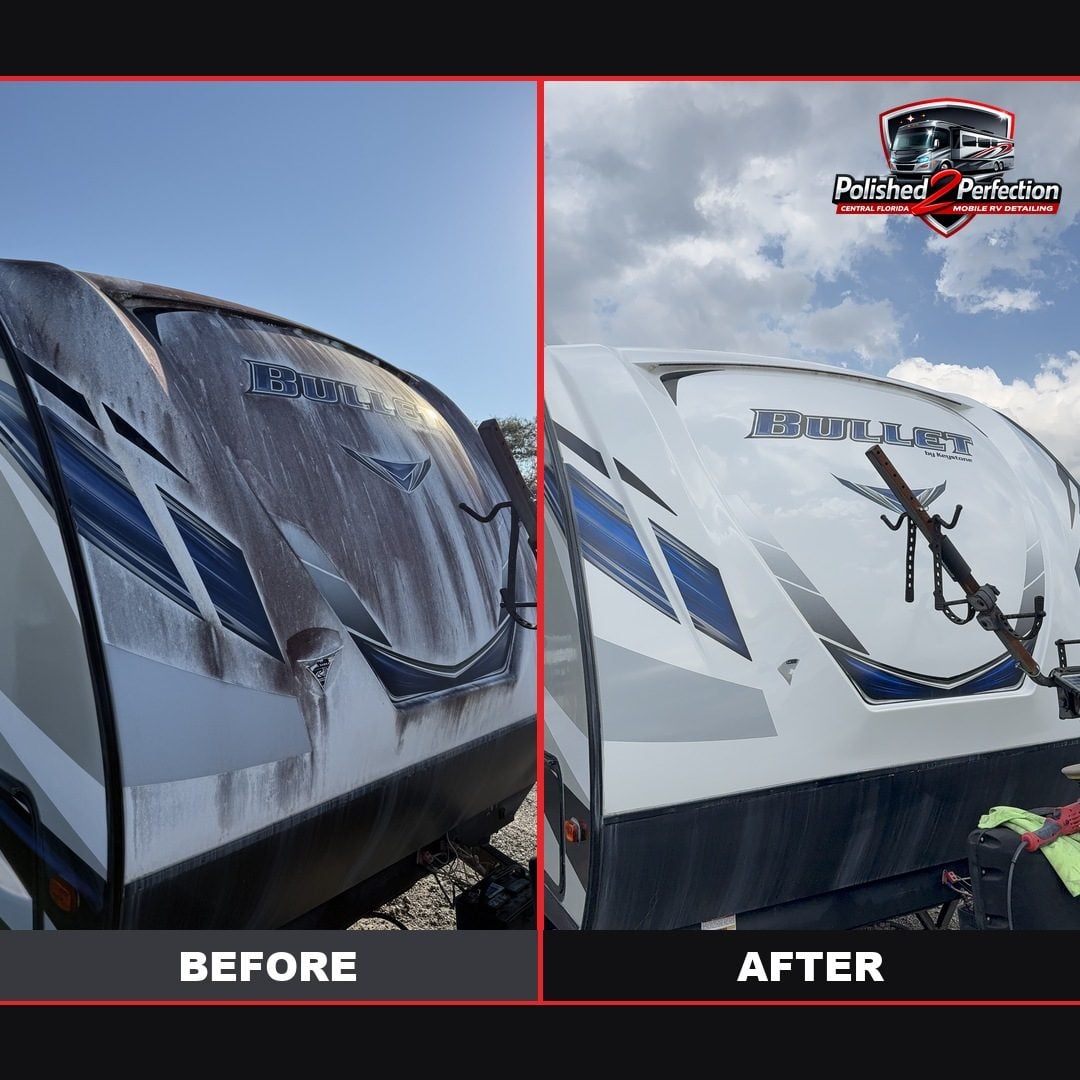
Then protection comes after correction. You can’t seal UV damage under a coating; the oxidation has to be compounded and polished out of the gelcoat first, and only then do you lock in the fresh finish with a sealant or ceramic. We walk through the whole process in our guide on how to remove oxidation from a fiberglass RV, and if the chalking is heavy or the gelcoat is thin, that’s a job for a machine polisher and the right pads, not a bottle of cleaner-wax. We restored an Ocala Class A last season that had gone fully chalky in under two years of sitting uncovered. It was recoverable, but a far bigger job than prevention would have been. Our mobile RV oxidation removal team brings the gloss back and then protects it so it doesn’t come straight back.
Key takeaways
- Florida UV is a year-round threat; the EPA scale shows protection is needed at UV 3+, and Central Florida sits there most of the year.
- Gelcoat is polyester resin, not paint. UV turns its surface to chalky powder, and the damage is cumulative and progressive.
- Front cap, driver-side wall, and roof fade first; check those with the fingertip test.
- Protect in layers: wash every 2 to 4 weeks, put a UV barrier on the gelcoat, condition the roof 2 to 3 times a year, and shade the rig when it’s parked.
- Wax is a stopgap in this climate; a ceramic coating is what actually holds the finish for a year or longer.
Frequently asked questions
How do I keep my fiberglass RV looking new in Florida?
Wash it every two to four weeks, keep a UV barrier on the gelcoat (a ceramic coating lasts far longer than wax here), condition the roof two to three times a year, and shade or cover the rig when it sits. The combination is what prevents fading; no single step does it alone.
How often should I wax my RV in Florida?
If you’re relying on wax, plan on reapplying roughly every month or two, because Florida UV burns through it quickly. That upkeep treadmill is exactly why most full-time Florida owners switch to a ceramic coating that holds for a full year or longer.
Does a ceramic coating stop RV oxidation?
It prevents it on healthy gelcoat by sealing the surface so UV can’t strip the resin bare. It does not reverse oxidation that’s already there; chalky gelcoat has to be compounded and polished first, then coated.
Can you reverse RV sun fade and oxidation?
Usually, yes, as long as there’s enough gelcoat left. Light-to-moderate chalking compounds and polishes out and then gets sealed. If the gelcoat has thinned to primer or is cracking, it needs professional assessment before anyone takes a buffer to it.
Is a cover or a ceramic coating better for sun protection?
They do different jobs and work best together. A cover or covered storage blocks UV while the rig sits; a ceramic coating protects the gelcoat whenever the rig is uncovered and in use. If you can only do one, coat the rig, because it’s protected full-time, including on the road.
Why did my RV’s front cap fade first?
Because it takes the most direct, sustained sun as the rig is parked, along with the driver-side wall and the roof. Those are the three areas we see chalk first on Florida rigs, so they’re where protection matters most.
Want it handled without buying a polisher and a weekend? We’re a mobile RV detailing crew and we come to you anywhere in Central Florida.
Get a free RV detailing quote