Florida Is the Harshest Place in America for Your RV’s Exterior
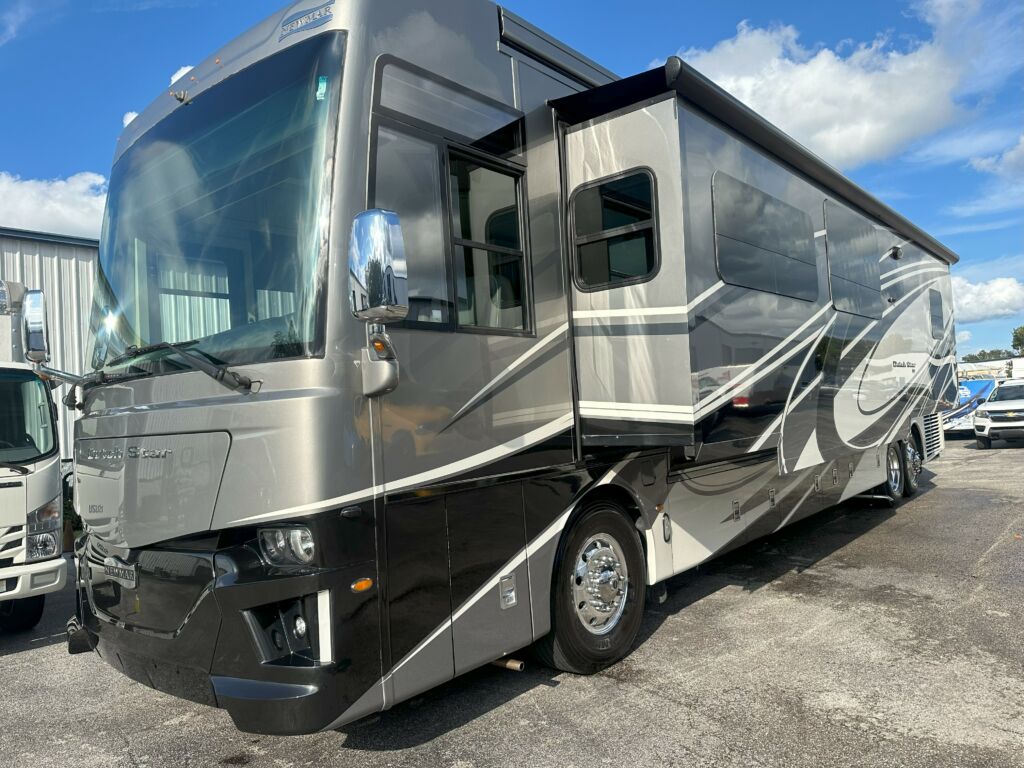
If your RV is parked anywhere in Florida — a driveway in Orlando, a campsite near the Gulf, a storage lot in Brevard County — the sun is quietly destroying its paint. Florida’s combination of intense UV radiation, high humidity, salt air, and year-round heat creates the most aggressive environment for paint oxidation in the continental United States.
Most RV owners don’t notice until it’s severe. By then, the surface has turned chalky, the gel coat is compromised, and what could have been a restoration job has become a far more costly repair. Here’s what oxidation actually is, why Florida accelerates it, and what professional mobile detailing can do to fix and prevent it.
What Is RV Oxidation?
Oxidation is the chemical breakdown of your RV’s protective gel coat or clear coat caused by prolonged exposure to UV rays and oxygen. Think of it like rust, but for paint. The outermost layer of protection gradually degrades, becomes porous, and loses its ability to repel moisture and UV radiation.
The result is the chalky, faded, dull-looking surface you see on neglected RVs. It often starts as mild haziness on south-facing panels — the sides that take the most direct sun exposure — before spreading across the entire vehicle.
Signs Your RV Has Oxidation
- Chalky white residue that wipes off on your hand when you run it along the surface
- Faded or dull color — the original brightness and depth of the paint is gone
- Rough or grainy texture on panels that used to feel smooth
- Inability to hold wax or sealant — products bead off without absorbing
- Spider-web cracking in the gel coat on severely affected areas
If you’re seeing any of these signs, oxidation is already in progress. The question is how far it has advanced and whether professional correction can restore the surface.
Why Florida Is Different
Most detailing guides talk about oxidation as a gradual, years-long process. In Florida, it happens faster — often visibly year over year. Here’s why:
- UV index. Florida consistently records some of the highest UV index readings in North America. The UV radiation that causes oxidation is more intense here, more days per year, than virtually anywhere else in the US.
- Heat amplification. Dark-colored RVs parked in direct sun can reach surface temperatures of 160–180°F. That thermal stress accelerates the chemical breakdown of clear coat and gel coat dramatically.
- Humidity and moisture cycling. Florida’s humidity causes daily moisture absorption and evaporation in porous, oxidized surfaces — a cycle that weakens the gel coat structure over time.
- Salt air. Coastal Florida RV owners face the additional challenge of salt particulates in the air, which corrode paint and metal trim even on vehicles that never touch saltwater.
The result: an RV in Florida can develop significant oxidation in 2–3 years without protection. The same vehicle stored in a moderate climate might go 6–8 years before seeing similar degradation.
What Professional Oxidation Removal Actually Involves
Consumer-grade wax and polish won’t fix oxidation. These products are designed to maintain surfaces in good condition — not to restore surfaces that have already degraded. True oxidation removal requires professional-grade compounding and polishing processes.
The Correction Process
Professional RV oxidation removal typically involves several stages:
- Thorough wash and decontamination. All surface contamination — road film, mold, algae, mineral deposits — must be removed before any correction begins. Working on a dirty surface embeds contaminants into the paint and creates deeper scratches.
- Wet sanding (for severe cases). On heavily oxidized gel coat, light wet sanding removes the most damaged outer layer to expose the undamaged material beneath. This requires experience and a steady hand — done incorrectly, it causes more damage.
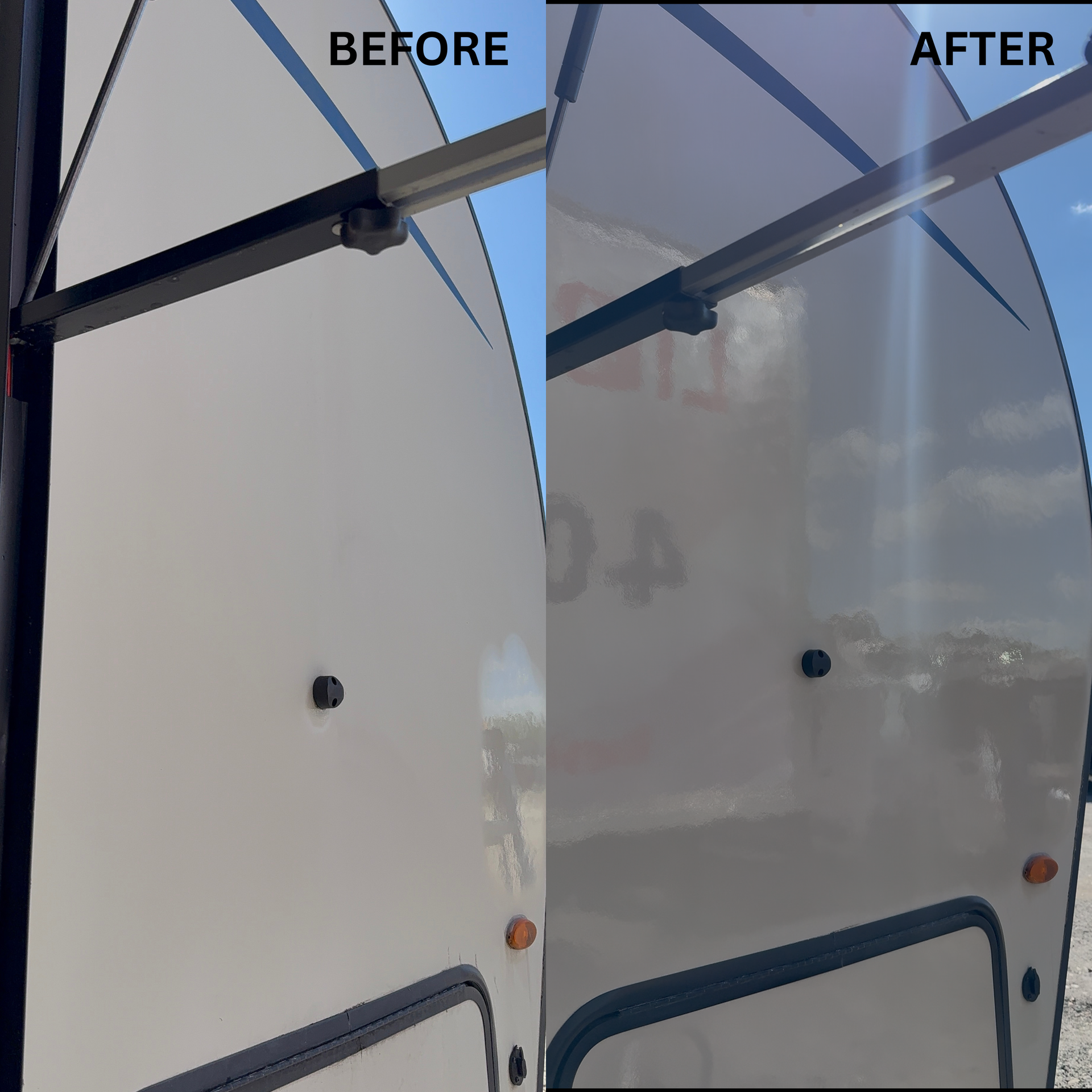
- Machine compounding. A professional-grade dual-action or rotary polisher with cutting compound removes the oxidized layer and levels the surface. This is where the actual restoration happens.
- Machine polishing. After compounding, a finer polish refines the surface, removes any light marring left by the compound, and brings out maximum clarity and gloss.
- Protection application. The restored surface is sealed with a high-quality ceramic coating, paint sealant, or carnauba wax to slow future oxidation and maintain results.
The entire process on a large RV can take 8–16 hours depending on size and severity. It’s not a quick job — and it shouldn’t be.
Mobile RV Detailing: Why It Matters in Florida
Taking a Class A motorhome or fifth wheel to a traditional detail shop is inconvenient at best and impossible at worst. Mobile RV detailing brings the equipment and expertise directly to your location — your driveway, your storage facility, your campsite.
For Florida RV owners specifically, mobile service means your vehicle doesn’t sit in the sun waiting at a shop while the appointment is scheduled. The work gets done where it lives, on your schedule, with professional-grade results you can see the same day.
How Often Should a Florida RV Be Detailed?
For Florida RVs without ceramic coating protection, professional detailing with oxidation inspection every 6–12 months is recommended. For vehicles that have been treated with a ceramic coating following oxidation correction, annual maintenance washes and inspections are typically sufficient to maintain the correction results.
The key is catching oxidation early — Stage 1 and Stage 2 oxidation are correctable with compounding and polishing. Stage 3 oxidation (where the gel coat has cracked or separated) often requires panel repainting, which costs significantly more.
Protect Your Investment Before It’s Too Late
An RV is a significant investment. For most Florida owners, it’s also tied to how they spend their retirement, their family vacations, and their weekends. A faded, oxidized exterior isn’t just an aesthetic problem — it’s a sign that the protective layers are failing, and the underlying structure is becoming vulnerable to deeper damage.
P2P Mobile Detailing specializes in professional RV detailing, oxidation removal, and paint correction services throughout Central Florida. We come to your location fully equipped and ready to restore your RV’s appearance — no appointment at a shop required.
Want the full breakdown — what oxidation actually is, the stage-by-stage severity guide, real cost ranges, and DIY vs. pro? Read our complete guide to RV oxidation removal in Florida.
Contact us today to schedule an assessment and get a quote for your RV’s condition.